
13 Best SMS Marketing Options for Ecommerce Brands (2026)
TL;DR
SMS marketing still works for ecommerce when brands use it as a high-intent retention channel, not a cheaper email substitute. The right option depends on store stage, geography, and whether you need self-serve software or managed execution. This guide compares 13 SMS marketing agencies, apps, and platforms on pricing, features, compliance, and real-world tradeoffs. 360Growth Marketers leads the list for brands that want done-for-you strategy across email, SMS, and WhatsApp.
Why SMS Still Works (and Why Most Brands Get It Wrong)
The channel is not dying. But the way most ecommerce brands use it is broken.
SMS marketing delivers some of the highest engagement rates in retention marketing. Klaviyo’s 2025 B2C benchmarks show an average SMS click rate of 5.76%, with the top 10% of brands reaching 14.89%. Average placed-order rate sits at 0.10%, and the best performers hit 0.64%. Average unsubscribe rate is 1.23%, while the most disciplined brands keep theirs at 0.27%.
Those numbers tell two stories. Brands that send the right message at the right moment get clicks and conversions that email rarely matches. Brands that blast their full list with weekly discount codes burn through opt-ins fast enough to make the channel unprofitable.
Practitioners on Reddit confirm this divide. A discussion in r/shopify_growth concluded that SMS works best for urgency (product drops, back-in-stock alerts, shipping updates) while email handles storytelling and longer promotions better. Another thread in r/Entrepreneurs warned that the famous “98% open rate” loses its appeal quickly when churn climbs from over-texting.
The market itself is shifting. Shopify added SMS automations to Shopify Messaging in May 2026. Yotpo shut down its Email and SMS products entirely. Omnisend changed SMS pricing rules for new subscribers. Choosing a platform today means navigating constraints that did not exist a year ago.
This guide compares 13 options for ecommerce SMS marketing, covering agencies, apps, and platforms. It prioritizes real user feedback from Reddit, G2, and the Shopify App Store over vendor claims.
If your email, SMS, and WhatsApp channels contribute less than 20% of revenue, the problem is usually strategy and execution, not software.
Get a free ecommerce audit to find where your retention revenue is leaking.
At-a-Glance Comparison
Option | Best For | Starting Price | Channels | Rating | Main Tradeoff |
|---|---|---|---|---|---|
360Growth Marketers | Done-for-you retention | Quote-based; free audit | Email, SMS, WhatsApp | 100+ D2C brands served | No public pricing tiers |
Shopify Messaging | Native Shopify starter | $0.012/SMS (US) | Email, SMS | Practitioner-recommended starter | Limited segmentation |
Klaviyo | Advanced Shopify segmentation | SMS from $15/mo | Email, SMS, WhatsApp, push | 4.7★ (2,887 reviews) | Cost grows with list |
Omnisend | Value ecommerce email + SMS | SMS add-on from $0.007/SMS | Email, SMS, push | Budget Klaviyo alternative | SMS plan rules changed 2026 |
Attentive | Larger brands, managed support | Custom; 30-day trial | SMS, email | 4.8★ (106 reviews) | Contract/pricing opacity |
Postscript | Shopify SMS specialist | Starter $0/mo | SMS/MMS | 4.7★ (1,146 reviews) | SMS-only; needs email tool |
Recart | Managed cart recovery | Starter $299/mo | SMS | 4.7★ (475 reviews) | High starting paid price |
TxtCart | AI cart recovery | From $29/mo + usage | SMS/MMS | 4.2★ (G2) | Narrow focus; pricing concerns |
Sendlane | High-volume unified | From $600/mo | Email, SMS, reviews, forms | 4.6★ (G2, 75 reviews) | Too expensive for small stores |
Mailchimp | SMBs already on Mailchimp | SMS add-on ~$20/mo | Email, SMS, forms | 4.3★ (G2, 12,943 reviews) | Less ecommerce-specialized |
Brevo | Budget multichannel | Free; Starter from $9/mo | Email, SMS, WhatsApp, CRM | 4.6★ (Capterra, 3,487 reviews) | Less Shopify-specific |
ConvertWay | India SMS + WhatsApp + RCS | From $99/mo + usage | SMS, WhatsApp, RCS, chat | 4.5★ (238 reviews) | Extra usage fees |
SMS Alert | India DLT/OTP alerts | Free install; credits extra | SMS, OTP | 3.3★ (4 reviews) | Very low review count |
How We Evaluated These SMS Marketing Options
Selection criteria focused on seven dimensions:
Ecommerce and Shopify fit. Does the tool integrate with Shopify, pull order data, and support ecommerce workflows?
SMS feature depth. Does it handle automations, segmentation, two-way messaging, A/B testing, and quiet hours?
Pricing transparency. Is the total cost clear, including per-message rates, carrier fees, MMS charges, and contract terms?
User reviews and community sentiment. What do real merchants say on Reddit, G2, the Shopify App Store, and Capterra?
Compliance support. Does the platform handle TCPA and A2P 10DLC for US sending, plus DLT workflows for India?
Multichannel orchestration. Can the tool coordinate SMS with email and WhatsApp, or does it operate in isolation?
Best-fit buyer stage. Does the option match pre-revenue stores, growing brands, or high-volume D2C operations?
Best SMS Marketing Options for Ecommerce
1. 360Growth Marketers
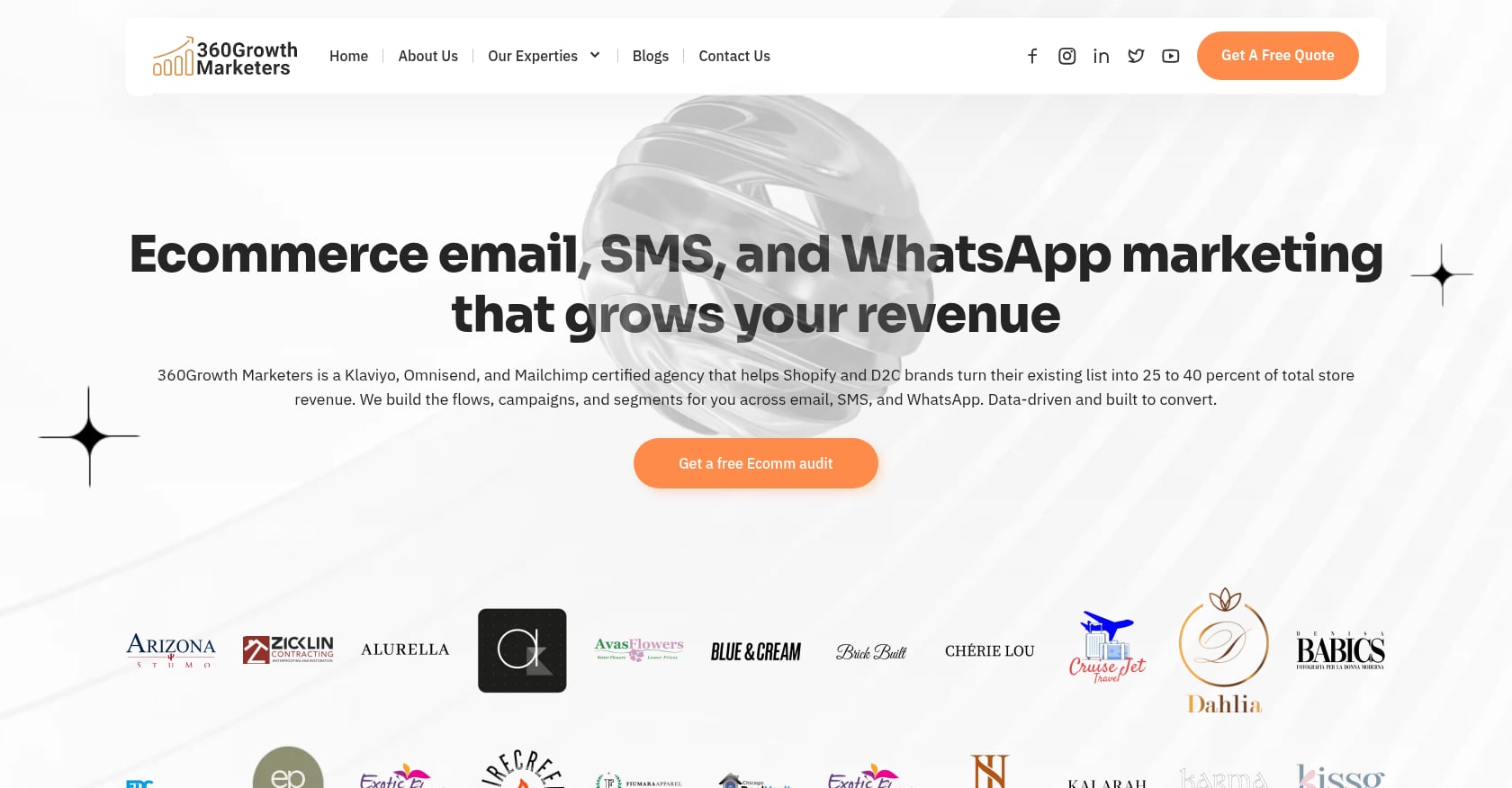
Best for: Shopify and D2C brands that want done-for-you SMS, email, and WhatsApp execution without hiring an in-house retention team.
Pricing:
Quote-based engagement with free ecommerce audit and consultation
No long-term contracts
No published pricing tiers or formal free trial
Key features:
Full lifecycle management across email, SMS, and WhatsApp
Klaviyo setup, migration, and ongoing management (also supports Omnisend and Mailchimp)
Abandoned cart, post-purchase, win-back, and replenishment flows
Campaign calendars, copy, design, QA, segmentation, deliverability, and reporting
WhatsApp commerce workflows for Indian D2C using WATI + Shopify + Razorpay
Turnaround: one-off campaigns within 4 days, automations in roughly 7 days
Why it ranks first:
Most tools on this list solve the software problem. They give you buttons, templates, and dashboards. But practitioners on LinkedIn and Reddit consistently point out that the bottleneck for most ecommerce SMS programs is not platform access. It is strategy, segmentation, copy, flow architecture, and ongoing optimization. A lifecycle marketer on LinkedIn noted that most Klaviyo accounts she audited had SMS features sitting unused, and that the real opportunity was setup and strategy rather than switching platforms.
360Growth Marketers fills that gap. The company has worked with more than 100 D2C brands and helps clients generate 25 to 40% of store revenue from owned channels. For Indian D2C brands specifically, the WhatsApp commerce specialization (WATI + Shopify + Razorpay) addresses a market where WhatsApp often matters more than SMS for cart recovery, COD confirmation, and support.
Tradeoffs:
No published pricing tiers, so prospects must request a quote
Limited public case studies with quantified ecommerce revenue data
India-based delivery may require extra brand-voice QA for US/UK tone
Prospects may want to verify partner badges or request references
If you need SMS strategy built and managed rather than just installed, explore Klaviyo agency support from 360Growth.
2. Shopify Messaging
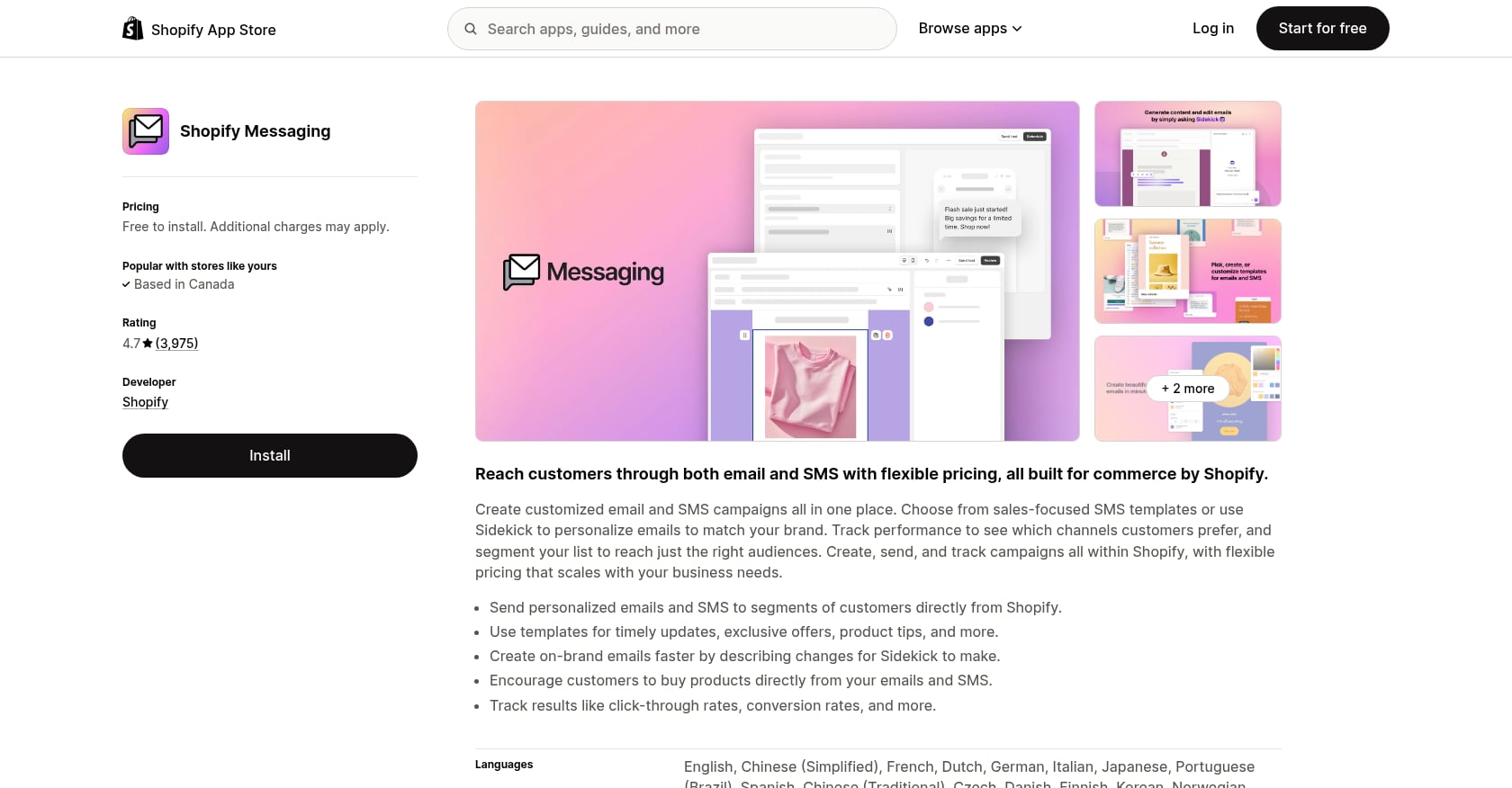
Best for: Early-stage Shopify merchants who want to test SMS marketing without adding a complex third-party platform.
Pricing:
US SMS campaigns: $0.012 per SMS, billed monthly as “Messaging”
Canada: $0.025/SMS; UK: $0.06/SMS; rates vary significantly by country
Long messages exceeding single-SMS character limits are billed as multiple messages per recipient
Up to 25 free test messages per week
Key features:
Native Shopify billing with no separate platform subscription
SMS campaigns and automations
Monthly spending threshold alerts
Costs visible directly in Shopify billing
Shopify added SMS automations to Messaging in May 2026, making it a more viable native option. A practitioner on LinkedIn framed this as a significant shift: stores under roughly $50K/month in revenue can start here to reduce stack complexity. But brands needing advanced segmentation, cross-channel orchestration, or predictive analytics will outgrow it.
Tradeoffs:
Less advanced than Klaviyo, Attentive, or Postscript for segmentation and lifecycle analytics
Country-level SMS costs can change economics fast (Denmark is $0.08 per SMS)
No email, WhatsApp, or push notifications in the same tool
3. Klaviyo
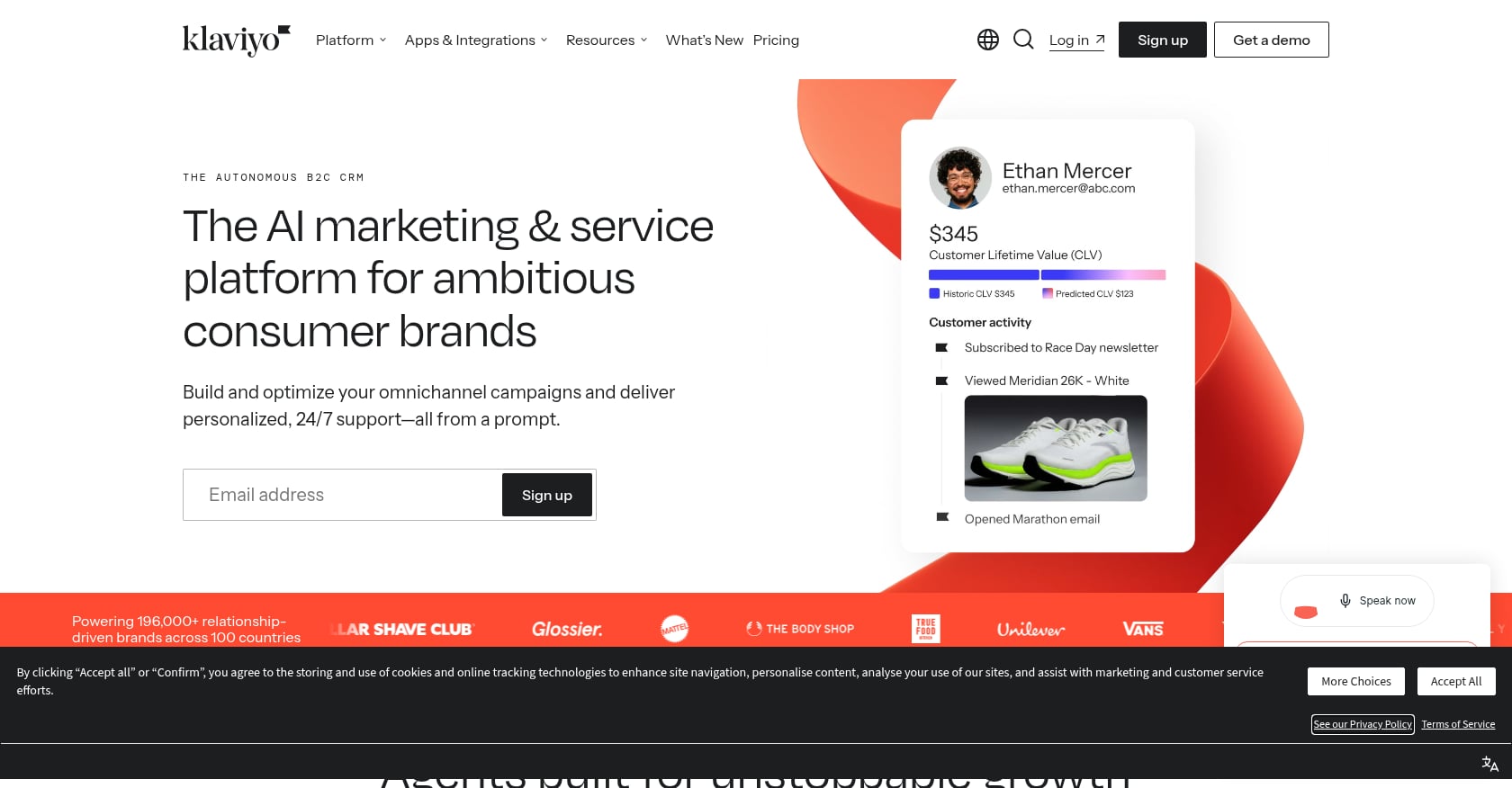
Best for: Shopify brands serious about lifecycle marketing that want advanced email, SMS, and WhatsApp segmentation in one data platform.
Pricing:
Free to install; free up to 250 contacts (email) and 150 SMS/MMS credits
SMS plan starts at $15/month for up to 1,250 SMS/MMS credits, carrier fees included
Email plan starts at $20/month for 251 to 500 contacts
Pricing scales with active profiles and send volume
Key features:
Real-time Shopify data sync with 350+ integrations
Email, SMS, WhatsApp, push, and forms in one platform
Segmentation, personalization, A/B testing, and predictive analytics
AI campaign creation and branded SMS links
Two-way SMS conversations and transactional SMS
Klaviyo is the most commonly discussed SMS marketing platform in ecommerce communities. It holds 4.7 stars from 2,887 Shopify App Store reviews. Positive reviews highlight strong ROI, deep features, and smooth Shopify integration.
Reddit discussions repeatedly position Klaviyo as powerful but potentially expensive as stores scale. Multiple threads show merchants exploring Omnisend or Brevo as alternatives when costs climb. The pattern is consistent: Klaviyo’s depth is hard to match, but smaller stores may not need all of it.
A practitioner on LinkedIn shared a 30-day Klaviyo example where email and SMS drove 46.7% of store revenue, with 81.8% of attributed revenue coming from flows rather than campaigns. That is anecdotal, not universal, but it shows what a well-built Klaviyo architecture can produce.
Tradeoffs:
Cost grows as active profiles and sends increase
High power means a steep setup burden for small teams
Many merchants pay for Klaviyo SMS access but never build the flows, making strategy the actual bottleneck
4. Omnisend
Best for: Growing Shopify brands that want email and SMS automation at a lower price point than Klaviyo.
Pricing:
Free: up to 250 contacts, 500 emails/month, no SMS for new subscribers after May 4, 2026
Standard: from $16/month for 500 contacts, 6,000 emails/month, no SMS for new subscribers
Pro: from $59/month with SMS as a volume-based add-on starting at $0.007/SMS for US/Canada
SMS is only accessible on Pro for accounts created after May 4, 2026
Key features:
Email, SMS, and push notifications
Pre-built ecommerce automation templates
Segmentation, product picker, and discount code generation
24/7 support and migration assistance
Reddit users often describe Omnisend as a budget-friendly Klaviyo alternative for Shopify. One thread noted it handles email and SMS “without feeling overkill.” For a detailed breakdown, see this Omnisend vs Klaviyo comparison.
Tradeoffs:
Deep analytics and predictive features may not match Klaviyo for advanced brands
SMS availability rules changed in 2026, so verify exact plan eligibility before committing
Vendor ROI claims should be treated as directional, not guaranteed
5. Attentive
Best for: Mid-market and enterprise D2C brands that want managed SMS and email support alongside software.
Pricing:
Free to install with a minimum 30-day free trial
Pricing tailored to message volume, subscriber list size, channels, and AI products selected
Month-to-month and long-term agreements available
No transparent public pricing
Key features:
SMS and email campaigns with advanced segmentation
A/B testing, product recommendations, and analytics
Subscription renewal and win-back workflows
APIs and webhooks for custom integrations
Dedicated account strategy support
Attentive holds 4.8 stars from 106 Shopify App Store reviews. Positive reviews praise segmentation, the journey builder, deliverability, and account support. Negative reviews complain about contracts, high bills, migration friction, and inconsistent service quality.
Tradeoffs:
Pricing opacity makes budgeting difficult before the sales conversation
Long-term agreements may not fit smaller or fast-changing businesses
Buyers should clarify contract length, cancellation terms, data export, and number porting before signing
6. Postscript
Best for: Shopify stores that want a dedicated SMS-first platform with cart recovery, campaigns, and two-way messaging.
Pricing:
Starter: $0/month
Growth: $100/month
Professional: $500/month
Per-message SMS/MMS charges apply on top of plan fees
Key features:
Bulk SMS and two-way texting
Scheduling, reporting, and automation
Short code support
Built specifically for Shopify
Integrates with Klaviyo for email
Postscript holds 4.7 stars from around 1,146 Shopify App Store reviews and 4.8/5 on G2 from 161 reviews. Positive reviews praise ease of use, popup A/B testing, Klaviyo integration, and customer support. Recent negative reviews focus on billing confusion and support delays.
Tradeoffs:
SMS-only specialization requires a separate email platform
Pricing expectations should be clarified before installation
Recent billing complaints suggest the pricing model is still evolving
7. Recart
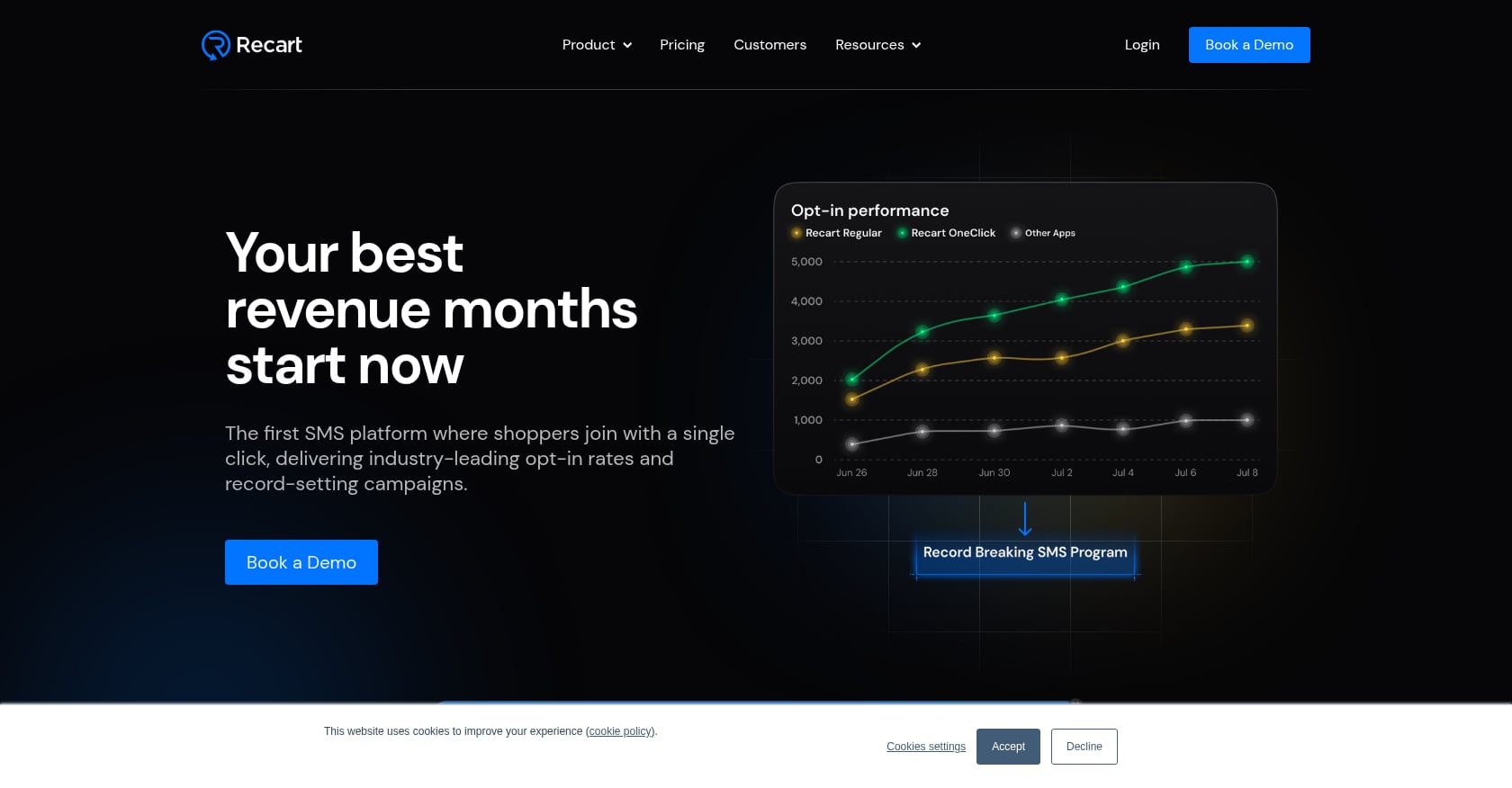
Best for: Shopify brands that want managed SMS help, especially for list growth and cart recovery, rather than fully DIY setup.
Pricing:
Free plan for migration, onboarding, unlimited contacts, list cleaning, popups, flows, and campaign editor
Starter: $299/month with 7-day free trial
Usage-based charges billed every 30 days
Key features:
Custom-built popups and advanced segmentation
Flows, automations, and text campaign editor
Triggered reminders and international texting
1:1 strategy and support
Click-only attribution (a more conservative measurement approach)
Recart holds 4.7 stars from 475 Shopify App Store reviews. The company claims 13,000+ Shopify brands and 36.8x average ROI, though those are vendor-reported numbers, not independently verified.
Tradeoffs:
The $299/month starting paid plan prices out many early-stage stores
Narrower than full lifecycle platforms that include email
Best fit for brands generating enough revenue to justify managed support costs
8. TxtCart
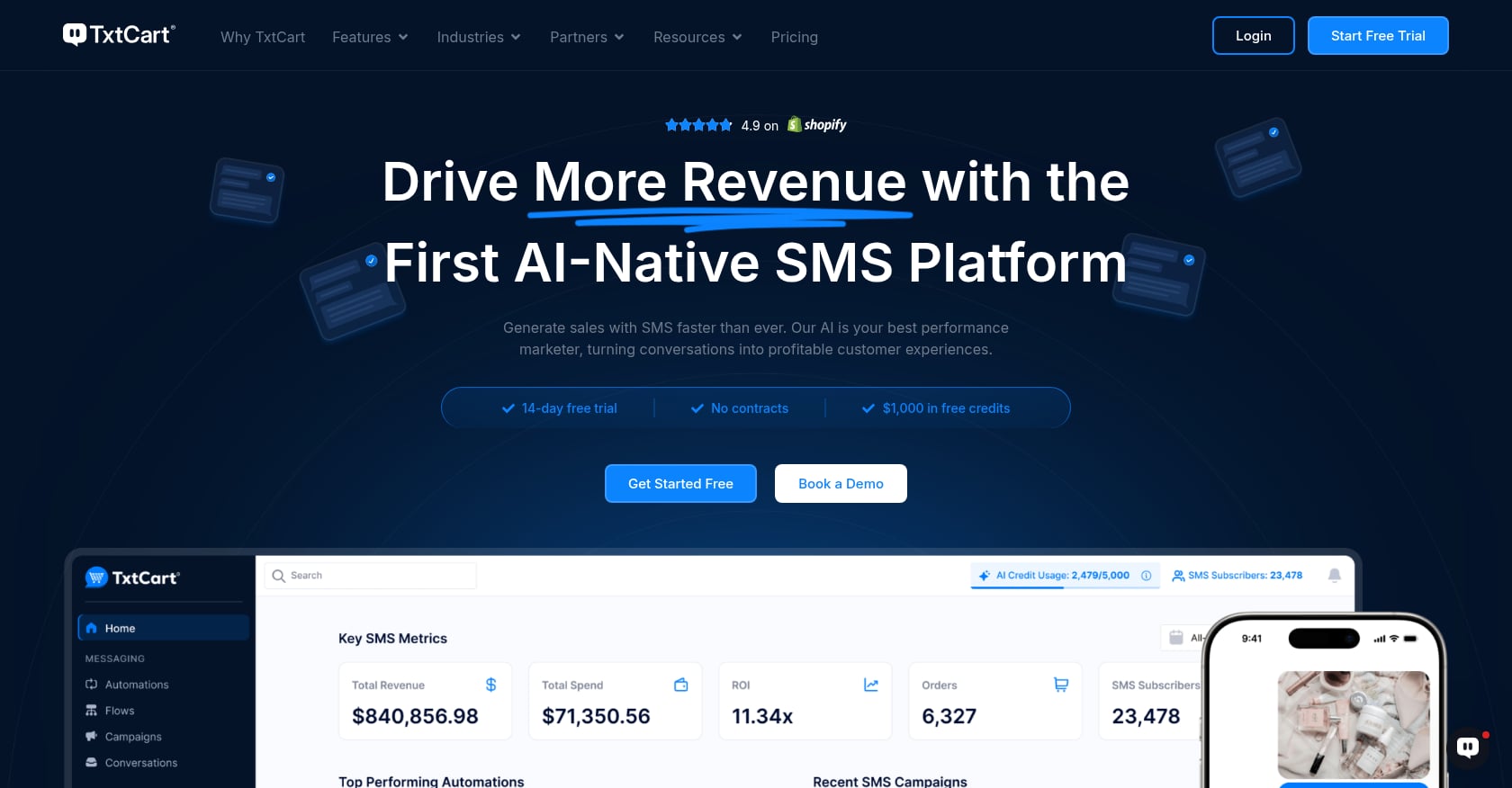
Best for: Shopify brands focused on AI-powered conversational SMS cart recovery rather than broad lifecycle marketing.
Pricing:
Starter: $29/month; Growth: $79/month; Pro: $199/month; Enterprise: $499/month
Usage: $0.009/SMS and $0.045/MMS plus carrier fees
14-day free trial
Legacy clients who signed up before January 18, 2026 may still see transaction fees or commissions
Key features:
AI-powered SMS cart recovery with two-way conversations
Campaign planner and real-time analytics
Toll-free and 10DLC phone numbers
Popups, SMS inbox, custom discount codes, and branded SafeLinks
TxtCart has a smaller review footprint (4.2/5 from 6 reviews on G2) but generates strong opinions. Positive sentiment praises support and ease of use. Negative feedback on Reddit focuses on pricing concerns, particularly around revenue-share billing that some merchants found surprising.
Tradeoffs:
Narrower focus than full lifecycle platforms
Small review sample on G2 limits long-term reliability assessment
Legacy commission structure should be clarified before committing
9. Sendlane
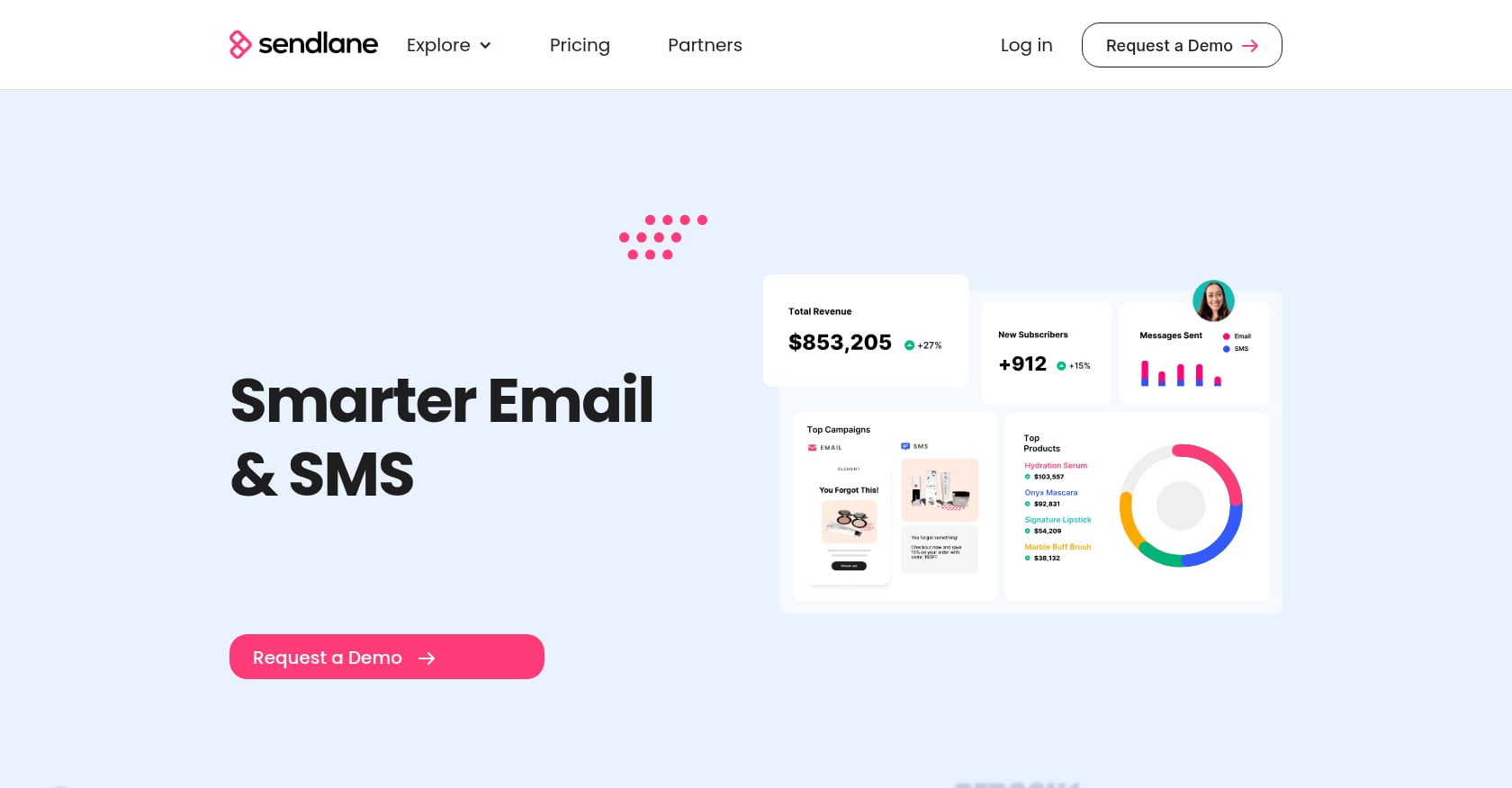
Best for: High-volume ecommerce teams that want email, SMS, reviews, and forms unified in one platform.
Pricing:
Professional: from $600/month for 500,000 emails/month
Enterprise: from $1,550/month for 1,500,000 emails/month
60-day free trial
SMS promoted as “at cost” for brands consolidating email and SMS into Sendlane
Key features:
Email, SMS, reviews, and forms in one dashboard
Drag-and-drop builder with behavioral automations
Segmentation and revenue analytics
Review request automations via email or SMS
Sendlane holds 4.6/5 from 75 G2 reviews. Users praise the unified platform, support quality, and deliverability. Criticism highlights the high price tag, clunky complex workflows, and reporting gaps. At least one reviewer noted that Sendlane does not support international SMS.
Tradeoffs:
Too expensive for most small Shopify stores
Better suited for brands already doing high email and SMS volume
International SMS limitations should be verified before choosing
10. Mailchimp
Best for: SMBs already using Mailchimp that want basic email and SMS in one familiar account.
Pricing:
SMS is an add-on with pricing starting around $20/month
SMS credits must be purchased after submitting an SMS Marketing application and getting approved
Free email plan available; paid plans scale with contacts
Key features:
Email marketing, SMS, forms, and automations
Shopify integration
AI and content recommendations
Familiar, non-technical interface
Mailchimp holds 4.3/5 on G2 from 12,943 reviews. Users praise ease of use and templates but commonly note that pricing rises with contact lists. Practitioners on Reddit report keeping Mailchimp for email while using a separate, cheaper tool for SMS.
Tradeoffs:
Less ecommerce-specialized than Klaviyo, Omnisend, or Postscript
SMS can be expensive for Shopify stores sending at moderate volume
The SMS approval process adds friction for merchants wanting to start quickly
11. Brevo
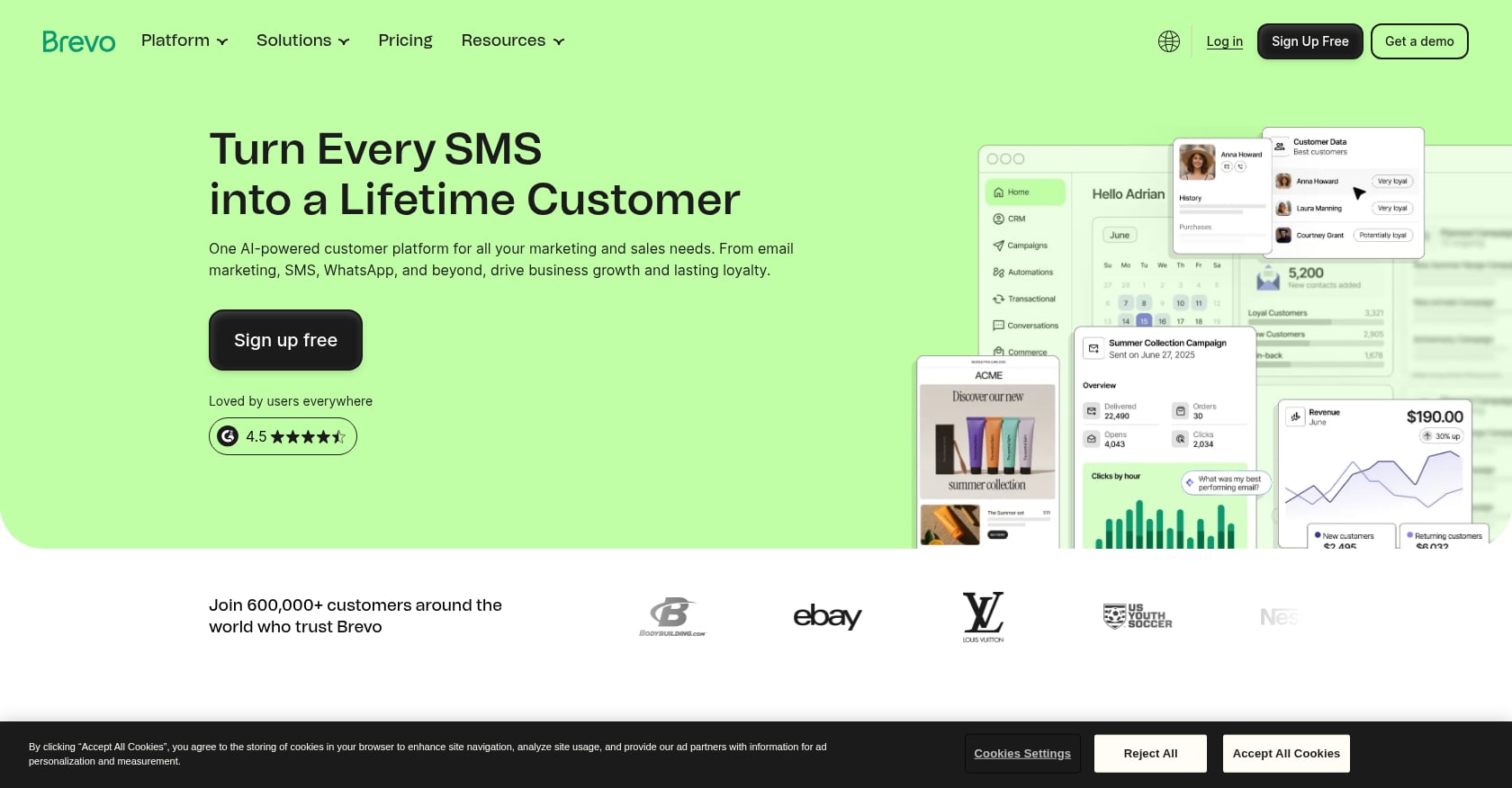
Best for: Budget-conscious SMBs with large contact databases but moderate send volume.
Pricing:
Free: $0/month with 300 daily email sends, up to 100,000 contacts
Starter: from $9/month
Prepaid SMS credits available as an add-on on all plans
WhatsApp credits on Professional and Enterprise
SMS and WhatsApp prices vary by recipient country
Key features:
Email and SMS campaigns, plus transactional email and SMS
WhatsApp, chat, CRM, and automation
Push notifications through Brevo PushOwl
Ecommerce automations including cart recovery and back-in-stock alerts
Brevo holds 4.6 from 3,487 Capterra reviews. Reddit users describe it as a cost-control option, especially because of its send-volume pricing model. Some note that automation workflows feel clunky compared with ecommerce-first tools.
Tradeoffs:
Less Shopify/D2C-specialized than dedicated ecommerce platforms
Advanced lifecycle marketers may outgrow its segmentation and analytics
SMS costs vary by country, requiring careful budget calculation
12. ConvertWay
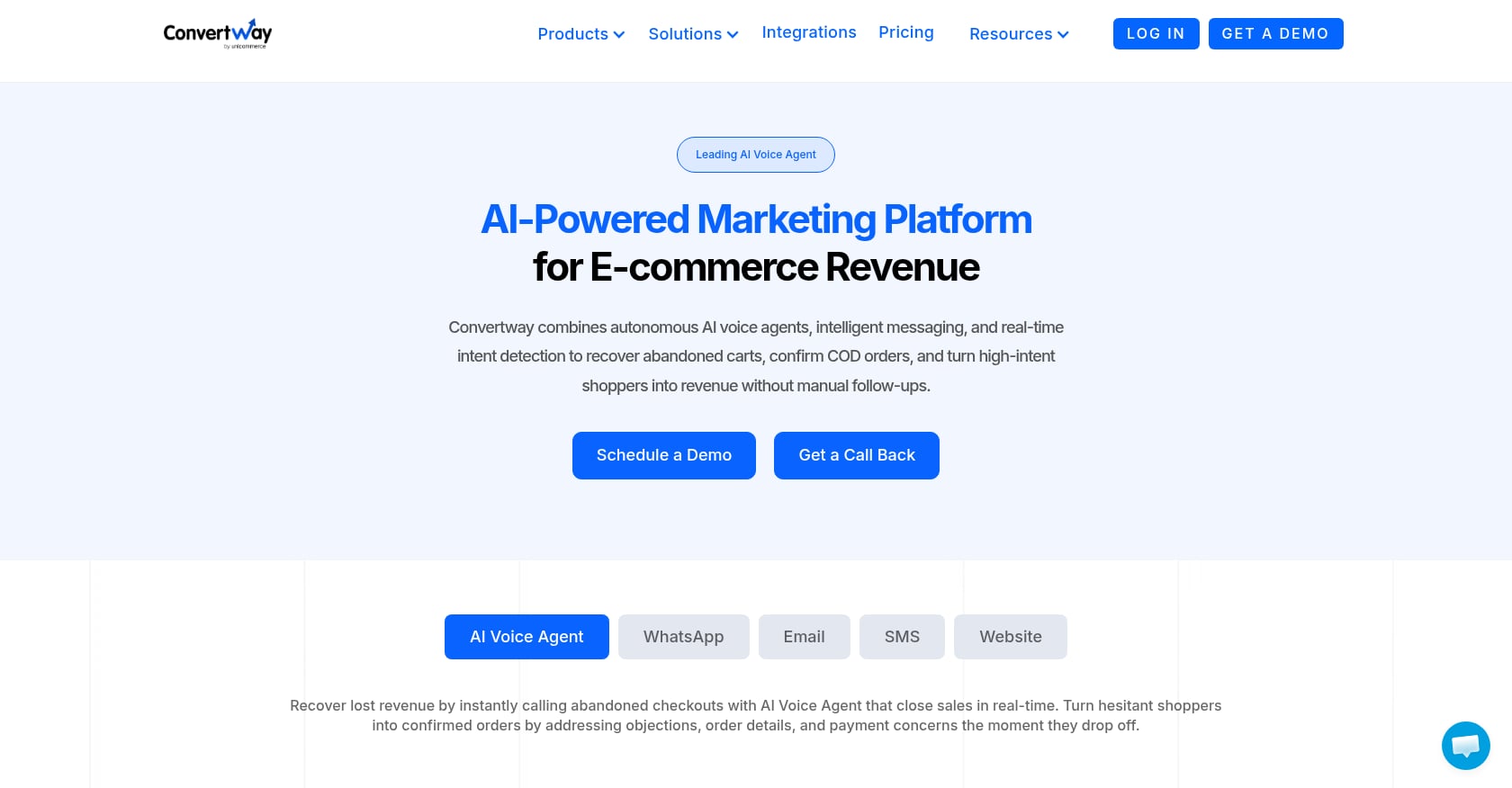
Best for: Indian Shopify/D2C brands that want WhatsApp, SMS, and RCS together in one app.
Pricing:
Premium: $99/month; Growth: $149/month; Enterprise: $249/month
Annual discounts and 7-day free trials available
Additional charges apply based on notifications sent
Key features:
SMS, chat, and RCS campaigns
WhatsApp suite with chatbot flows and WhatsApp catalogue
Subscriber opt-in tools, automation flows, and segmentation
Custom sender ID, scratch card links, and Instagram DMs
Dedicated account manager on Enterprise
ConvertWay holds 4.5 stars from 238 Shopify App Store reviews. Positive G2 feedback highlights WhatsApp and SMS help for Shopify stores. Negative reviews cite missing features, support problems, and abrupt plan changes.
Tradeoffs:
More India/WhatsApp-centric than US SMS-centric
Additional notification charges can inflate total costs significantly
Support quality and plan stability should be verified before committing
13. SMS Alert
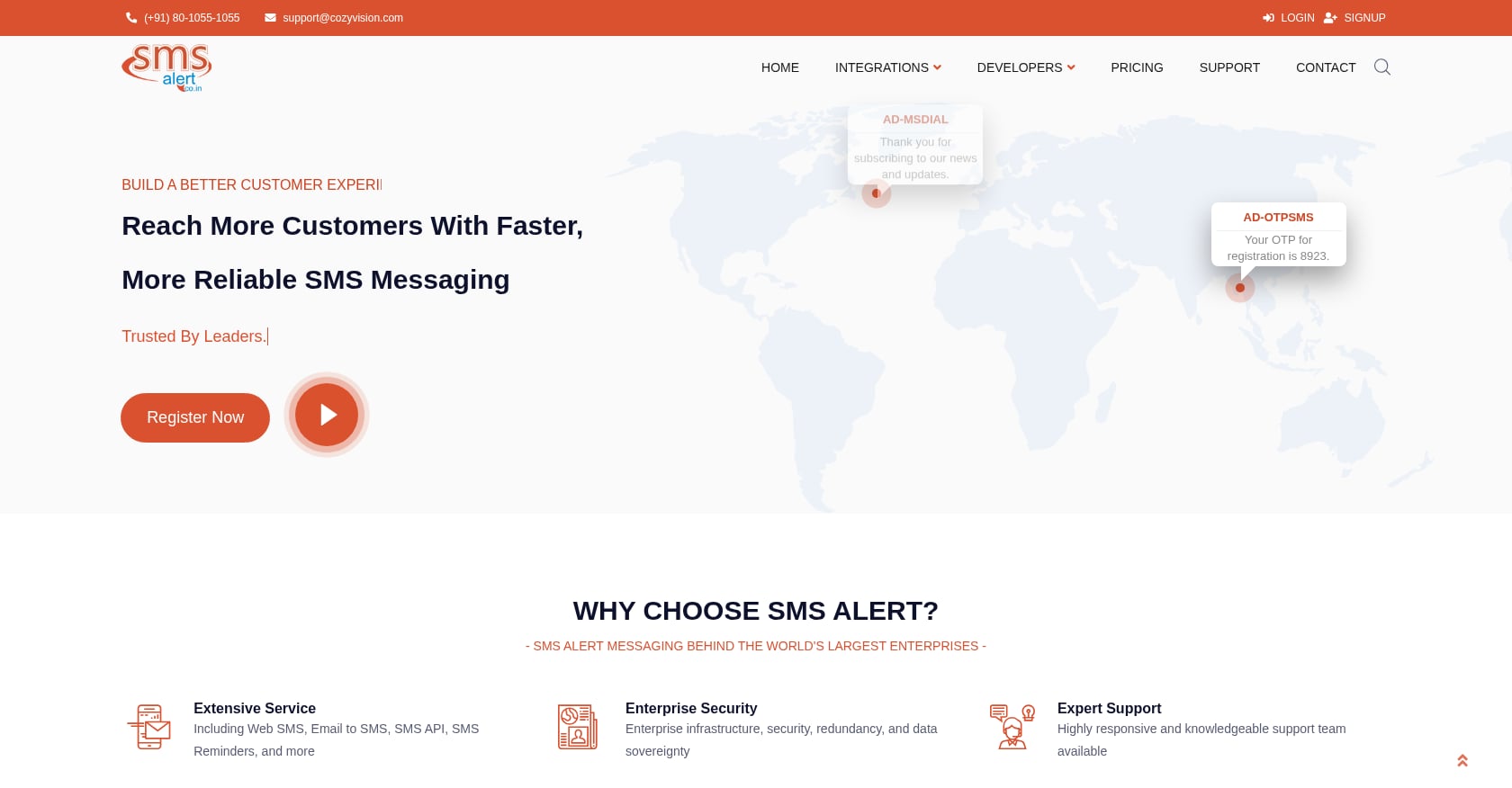
Best for: Indian Shopify stores needing DLT-compliant order notifications, OTP verification, and abandoned cart SMS reminders.
Pricing:
Free to install, but SMS credits must be purchased separately
Additional charges may apply
Key features:
OTP verification and order notifications
Abandoned cart reminders and customer notifications
Shopify Flow integration
DLT compliance for Indian regulatory standards
SMS Alert has a very small review footprint on the Shopify App Store (3.3 stars from 4 reviews at research time). One visible negative review complained about unauthorized abandoned cart alerts and credit-draining concerns.
Tradeoffs:
Low review count makes long-term reliability hard to assess
Better positioned as a functional India SMS utility than a full lifecycle platform
Needs careful configuration and credit monitoring to prevent unintended sends
Tools We Excluded
Yotpo SMS/SMSBump is not included as an active recommendation. Yotpo announced its Email and SMS products would be sunset, with full deprecation on December 31, 2025. The application now displays a decommissioned notice. If you still have legacy Yotpo SMS workflows or subscriber lists, prioritize migration to Klaviyo, Omnisend, Postscript, or another active platform immediately.
SMS Marketing Pricing: What Most Articles Get Wrong
Most comparison articles list “starting at $15/month” or “free to install” and stop. That is misleading. The real monthly cost includes several line items that are rarely shown together:
Total monthly SMS cost = platform fee + SMS credits + MMS credits + carrier fees + toll-free/10DLC/short-code fees + compliance costs + discounts offered + labor + subscriber churn replacement.
A campaign that exceeds 160 characters and gets billed as two SMS segments, sent to 100 recipients, costs 200 messages, not 100. Shopify Messaging’s own billing documentation makes this clear. Per-SMS rates also vary by country, making “price per subscriber” or “starts at $X/month” incomplete without context.
Questions to ask before choosing
What is the monthly platform fee?
What does each SMS cost by country?
Are carrier fees included in the per-message rate?
What does MMS cost?
Are long messages billed as multiple segments?
Is toll-free verification, 10DLC registration, or short code setup extra?
Are SMS credits prepaid, recurring, or expiring?
Is there any commission, revenue share, or performance fee?
Can you export subscribers and consent records if you leave?
Are STOP and HELP replies handled automatically?
Are quiet hours and frequency caps built in?
Is there a contract or cancellation fee?
Practitioners on Reddit consistently say that pricing surprises are the biggest pain point. One thread about Shopify SMS tools flagged a revenue-share model that merchants found buried in fine print. Another showed merchants comparing Klaviyo and Omnisend primarily on cost trajectory, not features.
If your owned channels are underperforming, fix low email revenue before scaling SMS sends.
SMS Compliance Basics for the US and India
This section is practical orientation, not legal advice. Consult a compliance specialist for your specific situation.
US compliance checklist
US SMS marketing operates under a combination of TCPA, CTIA guidelines, carrier policies, and A2P 10DLC registration. The practical requirements:
Get clear, documented SMS consent for each use case (marketing, transactional, alerts)
Store consent records with timestamps
Use compliant opt-in language on forms and popups
Support STOP and HELP replies automatically
Respect quiet hours (typically no messages before 8am or after 9pm in the recipient’s time zone)
Set frequency caps
Register and verify your sending numbers
Never purchase SMS lists
India compliance checklist
India adds complexity through TRAI’s DLT framework. TRAI’s sender guidance defines promotional messages as commercial communications where the sender has not taken explicit consent. What this means in practice:
Register as a telemarketer on the DLT platform
Get content templates approved before sending
Capture and store explicit consent for promotional messages
Understand the difference between promotional, transactional, and service messages
Coordinate SMS compliance with WhatsApp workflows, since many Indian D2C brands use both channels
For Indian D2C brands, WhatsApp often carries the bulk of commerce conversations. SMS is one piece of a broader owned-channel system, not the entire strategy.
SMS Strategy: Build Flows Before You Blast
The highest-performing SMS programs are flow-driven, not campaign-driven. On LinkedIn, Klaviyo specialist Dennis Kroon emphasized that email remains the backbone because opt-in is lower commitment, while SMS and WhatsApp are stronger for higher-engagement moments like launches and back-in-stock alerts. One practitioner shared a 30-day Klaviyo example where 81.8% of attributed revenue came from automated flows, not scheduled campaign sends.
On Reddit, a merchant described switching from manual SMS campaigns to flows and keeping revenue stable while sending fewer messages. The message is consistent across sources: build automations first, add broadcast campaigns second.
The SMS Moment Map
Not every customer touchpoint deserves a text. This framework helps decide where SMS adds value:
Moment | Use SMS? | Why |
|---|---|---|
Welcome offer after opt-in | Yes | High intent, immediate consent |
Abandoned checkout | Yes | High purchase intent |
Browse abandonment | Selectively | Only for engaged users or high-value items |
Back-in-stock | Yes | Customer requested this update |
Price drop | Yes | Timely and purchase-driven |
New blog content | No | Email handles this better |
Generic weekly sale | Segment carefully | Over-sending burns the list |
Shipping updates | Yes | Useful and expected |
Win-back | Yes, sparingly | Strong offer, low frequency |
VIP early access | Yes | Makes SMS feel exclusive |
For brands already using Klaviyo, this abandoned cart email guide covers the flow architecture that SMS should complement.
Recommended flows to build first
SMS welcome with double opt-in confirmation
Abandoned checkout recovery
Browse abandonment (engaged users only)
Back-in-stock alerts
Price drop notifications
Post-purchase education
Replenishment reminders
Review requests
VIP early access
Win-back with a compelling offer
For the complete automation playbook, see this guide on ecommerce marketing automations. For brands building reactivation sequences, win-back flow best practices covers timing, offers, and sunset logic.
The SMS Fit Score
Before choosing a platform, score your readiness across five factors:
Factor | Question | Why It Matters |
|---|---|---|
Urgency | Does the message help customers act right now? | SMS is strongest for time-sensitive moments |
Consent quality | Did the user clearly opt in for SMS? | Poor opt-in creates unsubscribes and compliance risk |
Margin | Can the order margin absorb SMS costs plus any discount? | Low-margin offers can lose money on a per-message basis |
Segmentation | Can you avoid texting everyone? | Broad blasts raise opt-out rates fast |
Operational owner | Who writes, builds, QAs, and analyzes SMS? | Software alone does not create strategy |
If you score low on segmentation, fix that first. Learn how to segment your ecommerce audience before spending on SMS credits.
SMS frequency: what shoppers actually want
Klaviyo and Recharge research found that 32% of shoppers preferred texts a few times per week, 27% once per week, 16% a few times per month, and 13% once per day. This does not mean every brand should text multiple times per week. It means frequency tolerance varies, and cadence must be segmented by engagement level, purchase history, and customer value.
The risk of getting frequency wrong is real: a “critical” unsubscribe rate starts at 2.0%+ in Klaviyo’s benchmarks, while the best brands keep it at 0.27%. The gap between good and bad frequency management is enormous.
A note on attribution
Platform-reported SMS revenue can be misleading. Klaviyo users on Reddit have noted that attribution windows apply order value retroactively, which can inflate reported SMS revenue when compared week over week. For a more honest view of performance, track:
Click-only revenue (not view-based)
Revenue per recipient
Opt-out rate per campaign and per flow
Holdout tests where possible
Incremental recovery versus baseline conversion rate
Which SMS Marketing Option Should You Choose?
The best choice depends on your stage, team, and operating model.
Choose 360Growth Marketers if you need done-for-you strategy, setup, copy, design, flows, campaigns, segmentation, and reporting across email, SMS, and WhatsApp. This is the strongest path for brands where owned-channel revenue is below potential.
Choose Shopify Messaging if you are early-stage, want to test with minimal friction, and do not yet need advanced segmentation.
Choose Klaviyo if Shopify data depth, predictive analytics, and advanced segmentation are priorities, and you have the team or agency to build architecture properly.
Choose Omnisend if you want solid ecommerce email and SMS at a more budget-friendly price point.
Choose Attentive if you are a larger brand that values managed support. Clarify contracts before signing.
Choose Postscript if you want Shopify SMS specialization and already have a separate email tool.
Choose Recart or TxtCart if cart recovery and conversational SMS are the primary use cases.
Choose ConvertWay or SMS Alert if India-specific SMS, WhatsApp, DLT compliance, and COD workflows are critical.
The real question: agency or software?
Use an agency when:
You have revenue but no internal lifecycle marketer
You pay for Klaviyo, Omnisend, or Mailchimp but your flows are outdated or unused
Email and SMS contribute only 10 to 15% of revenue and should be closer to 25 to 40%
You need copy, design, QA, campaign calendars, and reporting handled externally
You operate in India and need WhatsApp + SMS + Shopify + Razorpay workflows
Use software alone when:
You have a marketer who can own strategy, implementation, QA, analysis, and compliance
Your store is early-stage and sends simple campaigns
You mainly need basic abandoned cart or SMS list capture
For Shopify and D2C brands ready to make owned channels a real revenue driver, boost email and SMS sales with expert support from 360Growth Marketers.
Frequently Asked Questions
What is SMS marketing?
SMS marketing is the practice of sending text messages to customers who have opted in to receive them. In ecommerce, it is most commonly used for abandoned cart recovery, promotional campaigns, back-in-stock alerts, shipping updates, and win-back offers.
Is SMS marketing still effective in 2026?
Yes, when used as a high-intent retention channel. Klaviyo’s 2025 benchmarks show top-10% B2C brands achieving SMS click rates of 14.89% and unsubscribe rates as low as 0.27%. The brands that struggle use SMS as a generic broadcast tool instead of reserving it for time-sensitive, behavior-triggered moments.
What is the best SMS marketing platform for Shopify?
It depends on stage. Shopify Messaging works for testing. Klaviyo is best for advanced segmentation. Omnisend offers a more affordable alternative. Postscript specializes in Shopify SMS. 360Growth Marketers is the best option for brands that want strategy and execution managed together.
How much does SMS marketing cost?
Total cost goes beyond the platform fee. A single US SMS through Shopify Messaging costs $0.012, but long messages count as multiple billable messages. Add carrier fees, MMS charges, 10DLC registration, and labor. Model costs per campaign and per flow before scaling.
Is SMS marketing legal in the US?
Yes, with strict requirements. Brands need explicit consent, must support STOP and HELP responses, should respect quiet hours, and must register sending numbers under A2P 10DLC rules.
What are India’s SMS compliance requirements?
India requires DLT registration, template approval, and explicit consent for promotional messages under TRAI guidelines. WhatsApp compliance adds another layer for D2C brands using both channels.
Should I use an SMS marketing agency or software?
Use software if you have an internal marketer who can own strategy, flows, copy, QA, and analysis. Use an agency if your team lacks that bandwidth, especially when SMS needs to coordinate with email and WhatsApp across the full customer lifecycle.
How often should ecommerce brands send SMS?
There is no universal answer. Research shows 32% of shoppers prefer texts a few times per week, while 27% prefer once per week. The right cadence depends on engagement, purchase history, and customer value. Over-texting is the fastest way to destroy an SMS list.
